The goal of the “Numerical Simulation" PTC launched by the CEA is to foster a community of researchers and engineers within the CEA, covering a range of fields from conventional numerical simulation to artificial intelligence. The ultimate goal of this program is to promote cross-disciplinary collaboration on
innovative projects within the CEA, as part of a broader commitment to sustainability and strategic autonomy. It is within this framework that the project “Numerical Modeling of Cerebrovascular System Damage in Preeclampsia" was selected. This project is led by Christel Marquette, a researcher at
CEA-DRF/Irig/BCI/MAB2, in partnership with teams from
CEA-DRF/Irig/BGE/Edyp and
CEA-DES/DM2S/STMF/LDEI.
The objective of this project is to develop a
numerical hemodynamic model, based on the CATHARE code developed at the CEA, in order to create a mathematical representation of blood flow in the cardiovascular system, enabling the simulation of phenomena such as blood velocity, arterial pressure, and the stresses exerted on vascular walls. This model will be developed to study the dynamic interactions between the heart, brain, and placenta in pregnant mice within a pathophysiological context, the preeclampsia, paving the way for the
development of a personalized predictive tool for in silico therapeutic testing, dedicated to the prevention of postpartum neurovascular risk.
Preeclampsia (PE) is a pregnancy-specific complication characterized by maternal hypertension associated with elevated levels of placental inflammatory and vasoconstrictive factors. Currently, management relies primarily on close hospital monitoring, as there are no effective preventive strategies. However, beyond pregnancy, women who have had preeclampsia are at increased risk for chronic hypertension and persistent brain damage that can lead to stroke or cognitive impairment.
The project aims to determine how gestational hypertension alters cerebral vascular walls depending on their location and caliber. To achieve this, an integrated approach combining in vivo experimental data with computational fluid dynamics simulations will track the progression of vascular damage.
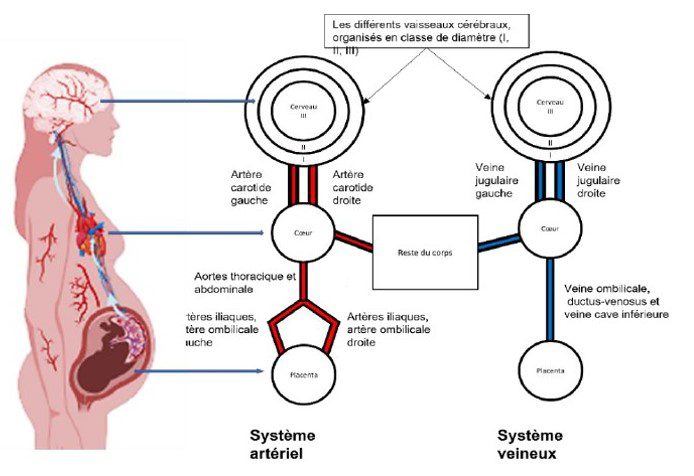
Figure : Graphical representation of the Vectamod-PE project: Numerical modeling using the CATHARE code of hemodynamic changes in the context of preeclampsia, incorporating the interactions between the systemic circulation, the placenta, the heart, and the cerebral vessels.
Partners information :
Christel Marquette, UMR 1292, CEA-INSERM-UGA CEA-DRF/Irig/BCI/MAB2.
Thomas Fortin, U13 CEA-DRF/Irig/BGE/Edyp.
Gauthier Fauchet, CEA-DES/DM2S/STMF/LDEI.