Diabetes affected 589 million people worldwide in 2024. To better understand this disease and test new treatments, researchers are studying the
islets of Langerhans*, which are responsible for insulin secretion and are dysfunctional in
type 1 diabetes*. Conventional approaches often group together many islets to measure insulin concentration, but this masks their individual differences. Furthermore, current systems rely on external and manually operated devices (such as syringe pumps or fluidic pumping systems), resulting in complex and less user-friendly workflows. This study presents an integrated and automated solution that enables the parallel analysis of multiple individual islets.
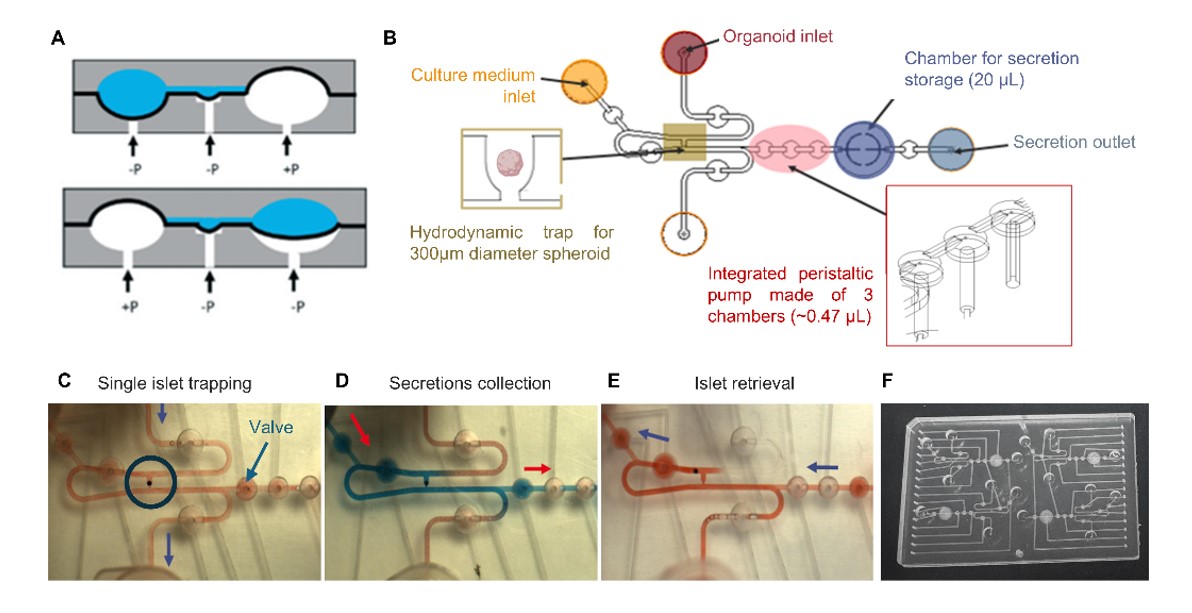
In collaboration with CEA-Irig/BGE/Biomics, researchers at CEA-Leti/DTIS/Semiv have developed an innovative microfluidic chip with an integrated micro-pump that circulates fluids, eliminating the need for bulky external pumps and ensuring ultra-sensitive measurement of secreted insulin. Thanks to precise flow control, the islets are individually captured in hydrodynamic traps. Through a collaboration, researchers from CEA-Irig/BGE/Biomics have performed functional testing in cell biology by using two biological models to measure the individual response of the islets:
spheroids* (from cell lines) and
human islets (from organ donations). Both models demonstrate remarkable viability of 99% and a robust response to glucose.
© CEA-Leti/DTIS/Semiv
Figure : Microfluidic chip. A) Structure of the microfluidic chip: a hyperelastic membrane sandwiched between two cyclo-olefin copolymer layers deforms inward under negative pressure (−P) to allow flow and is pushed against the upper layer under positive pressure (+P) to block flow. B) Schematic of the microfluidic platform comprising a hydrodynamic trapping region designed for 300 µm spheroids, an integrated micropump consisting of three valves (∼µL) for medium perfusion and secretion collection, and a downstream storage chamber for collected secretions. Experimental workflow: C) trapping of a single islet (within the hydrodynamic trap outlined in blue); D) actuation of the micropump to collect secretions (∼µL.min⁻¹); E) retrieval of the islet by reverse actuation of the micropump. Flow directions are indicated by blue and red arrows. F) Photograph of the microfluidic chip.
The originality of this study lies in the complete and automated integration, within a microfluidic chip, of a true lab-on-a-chip platform encompassing the entire experimental workflow, from the capture of a pancreatic islet and its perfusion to the functional assessment of its physiological response through the quantification of secreted insulin. This approach successfully reproduced the functional variability observed among islets from the same donor, demonstrating the platform's ability to preserve and reveal the intrinsic biological heterogeneity of pancreatic tissue. In the future, the integration of real-time sensors within this microfluidic circuit could provide an
ex vivo functional representation of patient physiology, facilitating the study of interindividual variability and the personalized evaluation of therapeutic responses.
FOCUS OSP program*: interdisciplinary program called “Focus Organoids on a Chip” to develop organoids on a chip (OSP) to promote groundbreaking concepts and technologies in the medical field. Co-supervision DRF/DRT (Anselme Perrier/ Fabrice Navarro).
Islets of Langerhans*: small clusters of cells located in the pancreas. Their role is to produce hormones (such as insulin) to regulate blood sugar levels (glycemia). These islets are implicated in diseases such as diabetes.
Type 1 diabetes*: chronic disease in which the autoimmune system alters the cells in the pancreas that produce insulin.
Spheroids*: three-dimensional aggregates of cells cultured in vitro, typically formed from cell lines.
Tutelles UMR : Univ. Grenoble Alpes (UGA), CEA (Leti et Irig), Inserm (UA13 BGE).
Fundings : Programmes FOCUS OSP et OOC inflexion du CEA ; LabEX GRAL (ANR-10-LABX-49-01).
Collaborations : AP-HP (Hôpital Saint-Louis), Centre Européen des Études sur le Diabète (CeeD, Strasbourg), ILONOV.